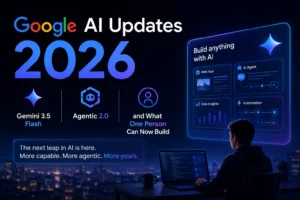

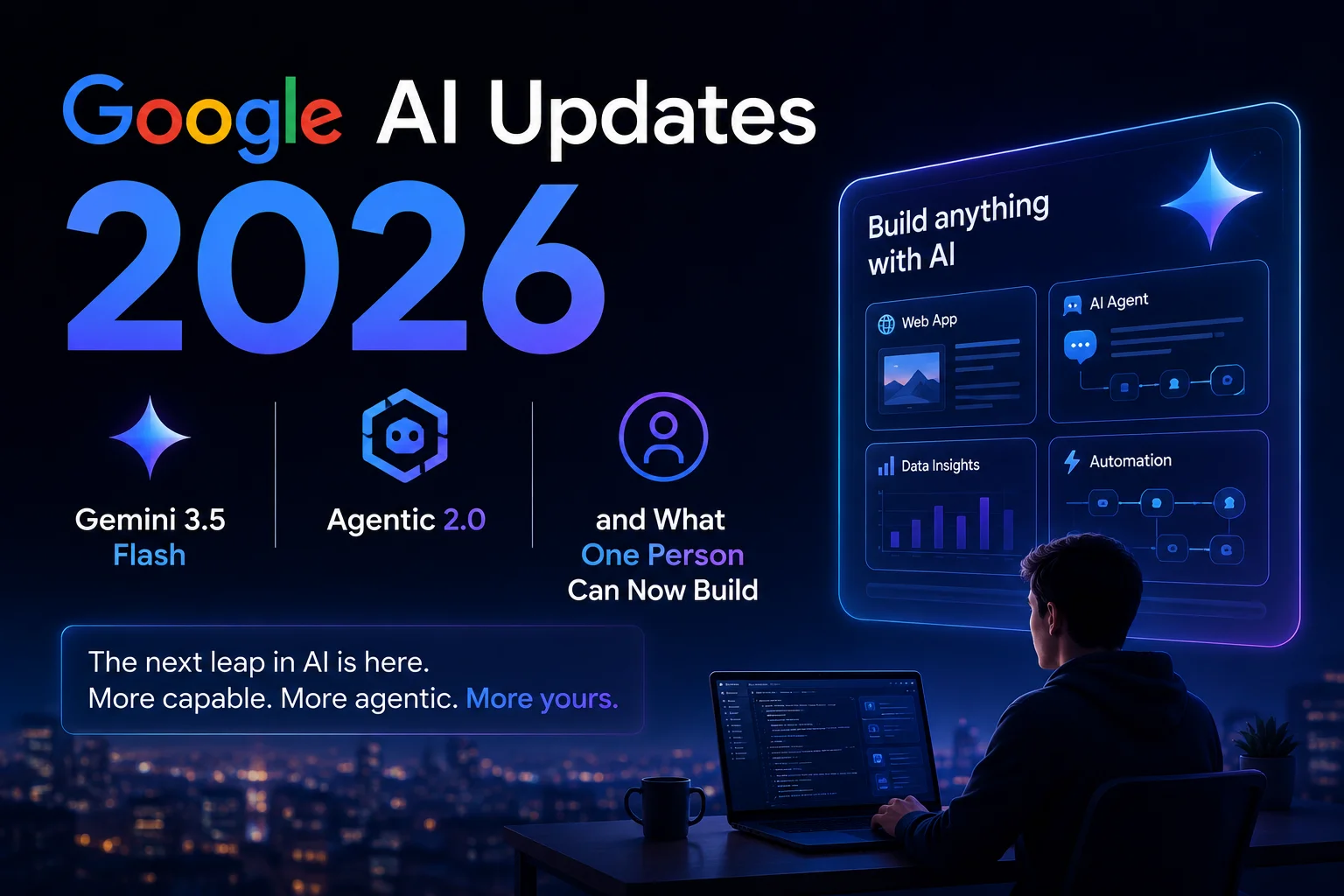
What changes do the Google AI updates of 2026 bring for businesses?
The Google AI updates 2026 matter because they address one of the biggest bottlenecks facing modern businesses: execution capacity. Google simultaneously released a faster reasoning model, a multi-agent automation framework, and a prompt-to-app development environment. Together, these updates make it possible for a single operator to execute workflows that previously required developers, marketers, designers, and operations support. For businesses focused on AI search visibility, automation, and AI-native development, the implications extend far beyond productivity gains.
The 2026 Google AI announcements are more than a collection of product releases. Together, they show how Google is evolving from offering AI-assisted experiences to building AI-native platforms that support reasoning, planning, and execution across Search, Workspace, Cloud, and developer tools. Rather than treating Gemini as a standalone chatbot, Google is positioning it as the intelligence layer behind its ecosystem. This architectural direction is particularly important for engineering teams designing production AI systems because it changes how applications interact with models, external tools, and enterprise data.
Google AI Updates 2026 at a Glance
Google’s latest AI announcements reveal a coordinated strategy rather than isolated feature launches. Gemini 3.5 Flash, Antigravity 2.0, AI Studio, AI Mode, and Search Agents all contribute to a broader vision where AI systems can reason, interact with software, and complete complex tasks with minimal user intervention. For developers, this means building applications around orchestration and workflow automation instead of simple prompt-response interactions.
| Update | What Changed | Engineering Impact |
|---|---|---|
| Gemini 3.5 Flash | Improved inference efficiency | Faster production workloads |
| Antigravity 2.0 | Multi-agent orchestration | Workflow automation |
| AI Studio | Expanded development tools | Faster prototyping |
| AI Mode | Gemini-powered Search | Conversational retrieval |
| Search Agents | Task execution | Agentic search experiences |
Sources to Reference
- Search Engine Land coverage of Gemini integration into Search
- SERoundtable reporting on Google AI announcements
- Official Google AI announcements
Google Gemini AI Updates June 2026: Gemini 3.5 Flash, Antigravity 2.0 & AI Studio App Builder

The model runs four times faster than the previous top-tier options and is now the default inference layer across Google Search and most Google consumer apps. Billions of people are already interacting with it without knowing the model changed.
What makes this release technically significant is not the speed. The faster, cheaper model outperformed Google’s previous flagship on challenging agentic benchmarks, including multi-step reasoning and code generation. That tradeoff is not supposed to resolve in the smaller model’s favour.
Normally, speed and capability trade off against each other. Fast models compromise on reasoning. Capable models are thorough but impractical for real-time use. Gemini 3.5 Flash breaks that pattern. On structured agentic tasks — those that require planning, executing, checking, and correcting the small, quick model now scores higher than the expensive flagship.
What’s New in the Google Gemini Update June 2026
Google continued expanding Gemini’s capabilities throughout June 2026 by improving model deployment across Search and developer platforms. These updates focused on practical performance improvements rather than introducing an entirely new model generation. Engineering teams benefit from faster inference, better integration with Google’s AI ecosystem, and more consistent behaviour across supported products. The emphasis on operational efficiency makes Gemini more suitable for production environments where latency, scalability, and reliability directly affect user experience.
Engineering Considerations
When evaluating the latest Google Gemini updates, engineering teams should look beyond benchmark scores. Production AI systems require monitoring, prompt version control, structured evaluation, and governance policies that ensure consistent outputs over time. Improvements in model capability only deliver value when applications are designed with observability and operational resilience in mind.
Engineering Perspective from Sumato Solutions
At Sumato Solutions, we recommend evaluating AI models as part of a complete software architecture rather than as isolated services. Model quality is important, but orchestration, monitoring, and secure integration often determine whether an AI application succeeds in production.
Why Gemini 3.5 Flash matters for AI search visibility
Gemini 3.5 Flash is not simply a faster model. It is increasingly involved in how Google evaluates, retrieves, and synthesises information across search experiences. Improvements in inference latency, context window handling, token efficiency, and retrieval-augmented generation enable the system to process more information and make better relevance decisions.
The practical implication is not that AI got faster, it’s that the latency ceiling for complex autonomous tasks dropped significantly. Jobs that previously required overnight queuing can now run inside a normal workflow loop. For businesses running retrieval audits or content pipelines, this changes what’s operationally possible in a single working day.
Agentic 2.0 — from single tasks to parallel AI workstreams
The original agentic framework ran one AI agent on a task sequentially. Agentic 2.0 removes that constraint. You can now run multiple AI agents in parallel, each handling a separate workstream, all completed simultaneously.
What is Antigravity 2.0 or Agentic 2.0?

Agentic 2.0 is Google’s multi-agent orchestration system designed for parallel execution and background task automation. Instead of waiting for one task to finish, multiple agents collaborate across workflows such as content creation, data processing, reporting, and system optimisation.
Antigravity CLI Migration: How to Switch from Gemini CLI Before June 18
Developers using Gemini CLI should migrate to Antigravity CLI before the June 18 deadline to avoid service interruptions for eligible individual accounts. The migration process includes installing Antigravity CLI, importing your existing plugins and configurations, updating authentication, and validating your development workflows. For complete instructions, refer to Google’s official migration guide and follow our step-by-step tutorial to ensure a smooth transition. Google’s official Antigravity CLI migration guide
AI agent scheduling automation in practice
One of the most powerful capabilities is AI agent scheduling automation. You can configure jobs to run in the background on a fixed schedule without human intervention. For example, an agent can extract analytics, generate reports, restructure content, and distribute outputs every week automatically — with no one present.
How multi-agent orchestration works
- One agent collects data.
- One agent processes insights.
- One agent generates outputs.
- One agent validates results.
All four run simultaneously instead of sequentially, compressing multi-hour pipelines into a single parallel pass.
Multi-Agent Architecture in Practice
Rather than relying on a single language model to solve every problem, modern AI systems distribute responsibilities across specialised agents. One agent may retrieve information, another may generate code, while a third validates outputs before execution. This approach improves reliability and allows complex workflows to be managed more efficiently than traditional chatbot architectures.
Gemini CLI end of life: June 2026
IMPORTANT: Gemini CLI reaches end-of-life on 18 June 2026 and is replaced by Agentic 2.0 CLI. Any automation, CI/CD pipelines, or scripts using the old CLI must be migrated before that date or they will stop functioning.
Build Android apps with AI using Google AI Studio App Builder
Google AI Studio now accepts plain-language instructions and generates working Android applications — no prior coding experience required for basic prototypes.
Prompt-to-prototype workflow
- Describe the app in plain language.
- AI generates a working prototype.
- Test inside a browser emulator.
- Refine using follow-up prompts.
- Deploy to device.
- Publish to Play Store.
What the App Builder handles
- UI layout generation
- Basic app logic
- Android compatibility adjustments
- Rapid prototyping
What still requires developers
- Complex authentication systems
- Advanced backend logic
- Security architecture
- Scalable production systems
Choosing Between AI Studio and Custom Development
AI Studio reduces the time required to prototype AI applications, making it suitable for proof-of-concept projects and internal tools. However, organisations with strict compliance, security, or integration requirements may still require custom software architectures. The decision should be based on governance, scalability, and operational requirements rather than development speed alone.
Choosing Between AI Studio and Custom Development
AI Studio reduces the time required to prototype AI applications, making it suitable for proof-of-concept projects and internal tools. However, organisations with strict compliance, security, or integration requirements may still require custom software architectures. The decision should be based on governance, scalability, and operational requirements rather than development speed alone.
iOS to Android migration with AI
The migration tool inside AI Studio significantly reduces duplication work for teams targeting both iOS and Android. It handles three major areas automatically: layout repositioning (adapting iPhone-native UI patterns to Android Material Design conventions), asset conversion (reformatting icon sets, splash screens, and image assets to Android specs), and UI adaptation (adjusting navigation patterns from iOS bottom tabs to Android’s standard structures).
What previously required a separate Android developer and days of manual asset preparation can now be done in a single afternoon. The tool does not handle backend logic or API integration — those still require a developer — but for UI-layer migration, it removes the most time-consuming manual work.
What is prompt engineering, and why does it still matter?
Prompt engineering remains critical because output quality depends heavily on input clarity. Well-structured prompts improve reliability, reduce hallucinations, and increase system consistency across Gemini-powered workflows and agentic systems. If you want to go deeper, book a call with our team to walk through prompt architecture for your specific use case.
Limitations of the Google AI updates 2026
- Outputs still require human review.
- Complex apps need iterative refinement.
- Agents fail when instructions are vague.
- Production systems require validation before deployment.
Google AI Model Performance After the June 2026 Update
Instead of focusing solely on benchmark improvements, engineering teams should evaluate how the latest Google AI updates affect production workloads. Lower inference latency can improve customer-facing applications, while better resource efficiency reduces infrastructure costs for high-volume deployments. Equally important is model consistency across long-running workflows, where predictable behaviour often matters more than isolated benchmark results.
What These Google AI Updates Mean for Enterprise Teams
Engineering leaders should view Google’s AI roadmap as an opportunity to modernise existing software architectures rather than replace them entirely. The most successful implementations are likely to combine AI reasoning with existing business systems, APIs, and governance processes. Instead of rebuilding applications around AI, organisations should identify repetitive workflows where autonomous reasoning can improve productivity without introducing unnecessary operational risk.
Conclusion: Google AI updates 2026 and one-person businesses
The significance of the Google AI updates in 2026 is not in any individual feature but in system-level convergence. Faster reasoning, multi-agent orchestration, and AI-native development tools now work together in a single ecosystem.
This enables a new category of one-person business AI tools in 2026 where individuals can build, automate, and scale systems that previously required full teams. As AI search visibility becomes more competitive, businesses that understand these systems early will gain a structural advantage in both organic search and AI-driven discovery. Sumato Solutions helps businesses implement exactly these systems — from agentic automation to AI search strategy.
.