
AI SEO 2026: What Stopped Working for Your Brand and What Does
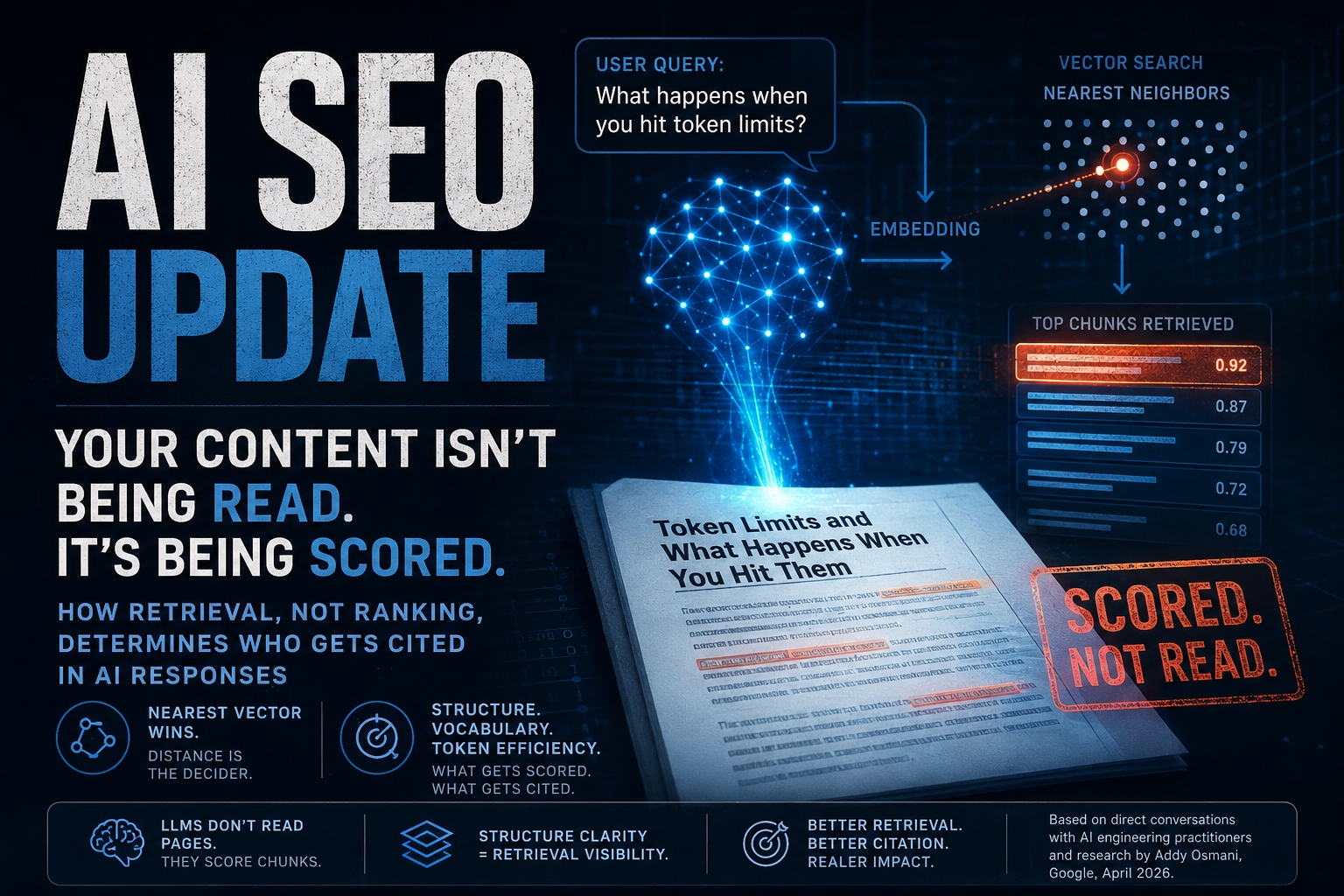
I spent an afternoon speaking with the head of AI engineering at a company (who understands LLM content retrieval deeply) that is building RAG pipelines. Not a theoretical conversation, this was someone debugging retrieval failures daily, tuning chunk sizes, and measuring embedding drift. He said something I keep coming back to: “The model doesn’t care about your content. It cares about distance. Nearest vector wins.” That sentence reframes the entire content and SEO industry
How Retrieval Actually Works
When a user queries ChatGPT, Perplexity, Claude, or any RAG-backed system, the model doesn’t fetch your page and read it top to bottom. It converts the query into a vector, searches for the closest matching vectors in its index, pulls those chunks, and generates a response from them.
Google AI Overviews
New data from 2025-26 suggest that Google AI Overviews will appear in the top 60% of Google search results in the United States. Most are informational searches, specifically how-to, what-is and comparison searches.
The AI overview rates have already changed to 70 to 80%. ChatGPT has 900 million weekly active users, up from 800 million in October 2023. And 58.5% of U.S. Google searches end without a click. The retrieval layer isn’t some future problem, but it’s where your content gets judged today, on every query that matters for your business.
This isn’t a product decision, it’s a physics problem. LLMs have finite context windows, typically between 100K and 200K tokens, depending on the model. A single bloated page can consume a meaningful fraction of that budget. When content exceeds what the agent can process usefully, it truncates, skips, or falls back to parametric memory, which means it generates content from training data rather than your actual content. The output may look accurate and be completely wrong about you.
Important Note:
Read More: How to Build an SEO Strategy for an AI-powered Strategy

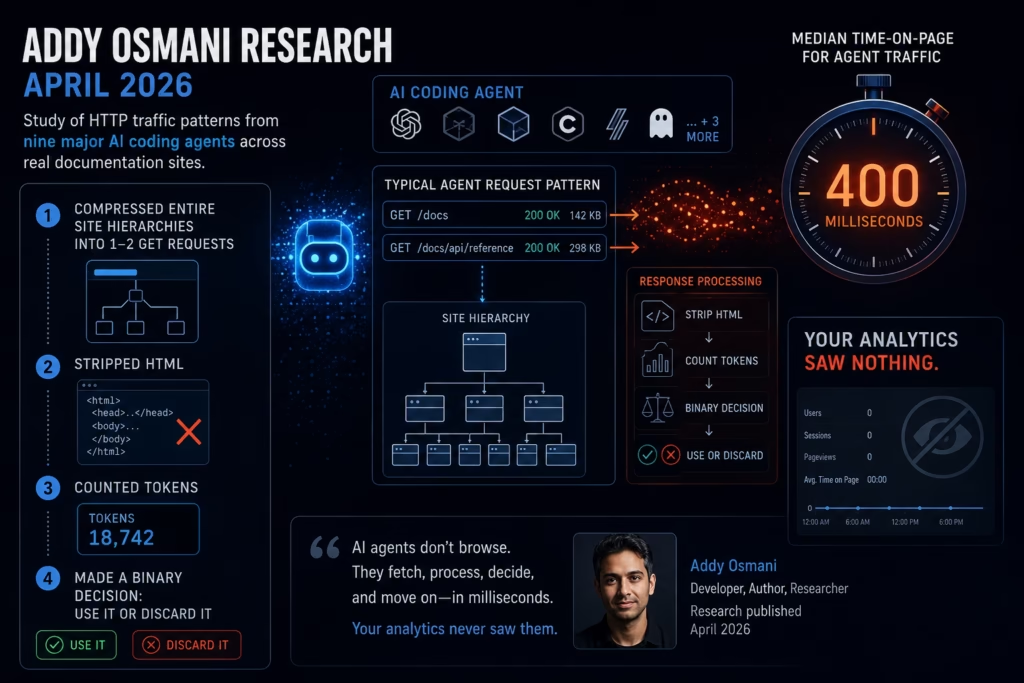
Addy Osmani published research on this in April 2026, studying HTTP traffic patterns from nine major AI coding agents across real documentation sites. Agents compressed entire site hierarchies into one or two GET requests, stripped HTML, counted tokens, and made a binary decision: use it or discard it. The median time-on-page for agent traffic was 400 milliseconds. Your analytics saw nothing.
Why Does Most Content Fail LLM Retrieval?
The content industry has spent a decade optimising for human reading patterns, progressive disclosure, narrative arc, conversational tone, and long-form depth. These patterns actively hurt retrieval performance.
Specifically
Structural Ambiguity Breaks LLM Content Retrieval. If a section heading doesn’t precisely signal what the section answers, the retrieval system has to infer it from the surrounding context. Inference is lossy. A heading like “Things to Consider” tells the model nothing. ” Token Limits and What Happens When You Hit Them” is retrievable.
Front-loaded noise
Content that buries the answer in three paragraphs gets chunked at the wrong boundary. The chunk that the model retrieves often contains setup, not substance. The answer is in the next chunk, which doesn’t become pulled.
Semantic vagueness.
LLMs rely on semantic proximity to the query. If your content uses different vocabulary from what your audience uses to ask questions, the embedding distance increases. This isn’t about keyword stuffing. It’s about vocabulary alignment. Tools like Semrush surface the exact phrasing, FAQs, and question structures real users generate. Content written in that language retrieves better, not because it gains anything, but because it’s actually closer in meaning to the query.
Token waste.
Read more: How to Build a Smart Content Strategy Using AI
Navigation elements, repeated boilerplate, legal footers, and decorative language, all of it burns the context budget. When an agent fetches your page, it processes everything. Every redundant sentence is a real cost.
The SEO parallel is real, not metaphorical.
Early search optimisation was about keyword density. Google got better, and the game shifted to topical authority, structure, and intent matching. The people who understood the underlying retrieval mechanism adapted. The ones who kept stuffing keywords disappeared.
The same shift is happening now, one layer up.
Google, Bing, and other search engines index the web. LLMs are trained on that index and query against it. The content that ranks well in search is largely the same content that surfaces in AI responses. There is no separate AI SEO track. The web presence you build feeds both systems from the same source.
What’s changed is the scoring function. Search engines weigh authority, backlinks, and click-through behaviour. LLM retrieval weights semantic proximity, structural clarity, and token efficiency. These aren’t identical, but they overlap significantly. A well-structured, precisely written, well-cited page performs well in both.
The practical implications of Content
Content strategy and retrieval optimisation are now the same discipline. Teams that separate them will underperform on both.
For teams still defining that foundation, the content strategy guide covers the baseline decisions worth getting right before optimising for retrieval.
How Do You Structure Content for LLM Retrieval?

Write for LLM Content Retrieval, Not Article Flow
Every section should be a self-contained answer. If a chunk extracted from the middle of your article makes no sense without the surrounding context, it won’t be retrieved usefully. This changes how you draft each H2 section, which should answer a specific question completely, not continue a narrative thread.
Match vocabulary to query patterns.
Use keyword research tools not for density but for vocabulary alignment. What exact phrasing do people use when they ask about your topic? Write in that language. The embedding distance between your content and real user queries should be as small as possible.
Cut structural waste.
Headers that don’t signal content, transition sentences that add no information, and conclusions that restate the introduction consume tokens without contributing to retrieval. Tighter content isn’t just more readable, it’s more retrievable.
Front-load the substance.
The first 200 tokens of any section set the retrieval anchor. If you’re burying your key point, you’re burying your retrievability. State the answer, then support it.
Treat token count as a content metric. Not word count. Token count. Agents operating under context pressure routinely truncate or skip pages that exceed 20K to 25K tokens. Track it.
Why SEO Practitioners Get Retrieval Wrong
Most content professionals don’t know what a context window is. Also, SEO specialists have never read a retrieval paper. Most marketers think “AI SEO” means writing content that sounds like it was written for a chatbot.
None of that is what this course is.
This approach is about understanding that the systems now mediating content discovery are retrieval systems, not ranking systems. They have specific technical behaviours. Those behaviours reward specific content properties. The gap between people who understand these concepts and people who don’t is already showing up in who gets cited in AI responses and who doesn’t.
That gap will widen.
Not Sure Where Your Content Stands in AI Search?
If you are not sure where your content stands in retrieval systems, that is the right starting point. Sumato Solutions audits LLM content retrieval across your existing pages, identifying which chunks are being scored, which are being skipped, and where the structural failures are. The audit is scoped, not a sales call.
Book a session here: https://calendly.com/sumatosolutions/30min